





Madhya Pradesh: 2 Muslim Congress corporators booked for refusing to sing ‘Vande Mataram’
The incident led to tension affecting social and religious harmony and created differences among the public, the police said.

Two Muslim Congress councillors were booked in Madhya Pradesh’s Indore after they refused to sing the patriotic song Vande Mataram during the budget session of the municipal corporation last week, IANS reported on Wednesday.
The case was filed under sections of the Bharatiya Nyaya Sanhita pertaining to promoting enmity between different groups on the grounds of religion, race and place of birth, and doing acts prejudicial to the maintenance of harmony, following complaints from Bharatiya Janata Party councillors, The Indian Express reported.
Additional Deputy Commissioner of Police Ram Snehi Mishra said that Rubina Iqbal Khan and Fauzia Sheikh Aleem allegedly disrespected the national anthem, IANS reported.
Mishra added: “During the inquiry, it was also observed that the incident led to tension affecting social and religious harmony, and created differences among the public.”
The incident took place on April 8 during the civic body’s budget session, when a dispute erupted over the singing of Vande Mataram.
Aleem questioned whether any rule or law required the singing of the song and later walked out of the House, while Khan said during the proceedings that her faith did not permit its recitation, The Times of India reported.
The exchange triggered protests from BJP members inside the House, who purportedly shouted: “If you have to live in India, you will have to say Vande Mataram!”
“भारत वर्ष में रहना होगा, तो वंदे मातरम कहना होगा!”…..: BJP पार्षद
— Shubham Shukla (@Shubhamshuklamp) April 8, 2026
वंदे मातरम को लेकर इंदौर नगर निगम में हंगामा।
कांग्रेस पार्षद फौजीया शेख अलीम ने कहा कि वंदे मातरम जबरदस्ती नहीं बुलवा सकते। ये कहते हुए सदन से हुई बाहर!
वैसे वंदे मातरम कहने में आपत्ति क्या है? pic.twitter.com/5MjEtCvHpF
Khan later apologised for her “provocative” choice of words, the newspaper reported.
Police officers said that both councillors were questioned for two days before the FIR was registered, The Indian Express reported.
Assistant Commissioner of Police Vinod Dixit told the newspaper that they “cited religious reasons” during the questioning. “We told them they were elected to a constitutional post and their religious compulsions should not have been part of the decision,” the newspaper quoted him as saying.
Chief Minister Mohan Yadav on Saturday said that the incident “was unfortunate” and reflected “poorly on the character of Congress representatives”, ANI reported.
He said that senior Congress leaders, including state president Jitu Patwari and national leader Rahul Gandhi, should explain why such behaviour was being encouraged, which he described as “insulting the sacrifices of patriots”.
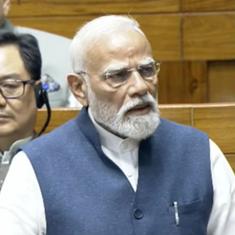
Yadav further said Prime Minister Narendra Modi had “won the nation’s heart” by embracing all six verses of Vande Mataram, while alleging that Congress remained “trapped in its double standards”.
#WATCH | Bhopal, Madhya Pradesh: On Congress councillor refuses to sing Vande Mataram in Indore, CM Mohan Yadav says, "... A Congress councillor refused to sing Vande Mataram in the municipal council was unfortunate, reflecting poorly on the character of Congress representatives.… pic.twitter.com/DWkf3FCHUj
— ANI (@ANI) April 11, 2026
On January 28, a Union Ministry of Home Affairs circular directed that all six stanzas of Vande Mataram be sung first when it is played together with the national anthem Jana Gana Mana.
Only the first two stanzas of the song had been played at official functions earlier. The remaining stanzas, which invoke Hindu goddesses Durga, Lakshmi and Saraswati, had been omitted.
In October 1937, the Congress Working Committee had passed a resolution adopting the first two stanzas of Vande Mataram as the national song. The Bharatiya Janata Party has long alleged that the Congress had agreed to drop the four stanzas to “appease Muslims”.
Vande Mataram was written in Sanskrit by Bankim Chandra Chatterjee in 1875 and is a popular patriotic song from India’s freedom movement.
A Press Information Bureau note issued on November 6 to mark 150 years of the song stated that the Constituent Assembly had adopted Jana Gana Mana as the national anthem and Vande Mataram as the national song.
The note quoted Rajendra Prasad, the first president, as having told the Assembly in January 1950 that Vande Mataram, because of its role in the freedom movement, “shall be honoured equally with Jana Gana Mana and shall have equal status with it”.
However, the Constitution mentions only the national anthem, not Vande Mataram.
Also read Vande Mataram debate: The novel in which the poem appears is a cry for freedom – but from whom?
